
Number property
Manage number properties in Optimizely CMS 13. Learn to configure integer, float, and decimal fields for precise content data.
The Number property type stores integer or float values with minimum and maximum validation. Use it to add numeric fields, such as quantities, ratings, or measurements, to your content types. It renders as a number input field in the All Properties edit view. The following image shows Number property type examples.
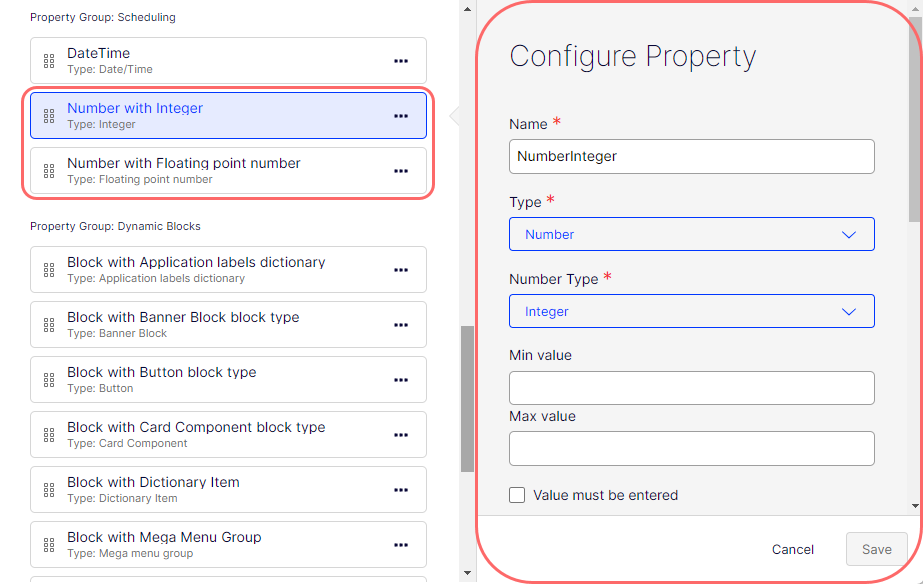
Configure Number property
The following attributes are available when you configure a Number property.
-
Name – Enter the name of this Number property type. This name is used for programming and language settings.
-
Type – Lets you change the content type to any other.
-
Number Type – Select one of the following:
-
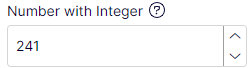
Integer – Enter an integer. It looks similar to the following image when rendered in the All Properties edit view.
-
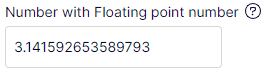
Floating point number – Enter a number with up to 15 numerals to the right of the decimal point. It looks similar to the following image when rendered in the All Properties edit view.
-
-
Min value – (Optional) Enter a minimum number value that a user can enter. For example, you can ensure an entered number is not negative by entering 0.
-
Max value – (Optional) Enter a maximum number value that a user can enter. For example, you can ensure an entered number does not exceed 92.

-
Value must be entered – Select to require the user to enter a value in a Number field. Required fields display a red asterisk (*).
-
Unique value per language – See Define language-specific properties.
-
List – Unavailable.
-
Property Indexing Type – Select one of the following to determine how the property is indexed for search. The correct setting depends on the nature of the data in the property and how you intend users to search and query data.
- Default – The property is stored and returned in query results, but excluded from all filter, sort, facet, and full-text search operations. Intended for display-only fields.
- Queryable – Indexes in a way to be part of search queries. For example, this indexing type lets you run a search query such as Find all pages where PropertyName equals Value.
- Searchable – Search data inside the property through the search function. For example, use it as part of a free text search where the system looks through searchable fields to find a match. This is useful when you want a content editor or end user to search a body of text, like a product description. It is beneficial to avoid undesired property values in the search index. By default, all properties are searchable.
- Disabled – The property is not indexed for searching purposes. It is not used in search queries, and its content is not searched. This is often used for properties that contain data irrelevant to search results, and disabling the index enhances system performance.
-
Default value – Select the options to define what value the Number field displays.
-
No default value – The field is empty (no pre-populated content).
-
Inherits value – The field value is derived from another source. This is often used in hierarchical systems where child elements inherit values from their parent elements. For example, a sub-page inherits some property values from its parent page.
-
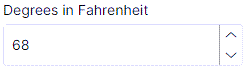
Custom – Enter the field's default value. For example, you can set the default starting value for Degrees in Fahrenheit to 68.
-
-
Display in edit view – Select to display this Number element on your page. Clear it to hide the number element while keeping all the property information.
-
Display name – Enter the text you want to display above the Number element on the page in the All Properties view.
-
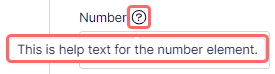
Help text – Enter text to display next to the Display Name. The following image shows how help text displays.
-
Sort index – Specify a value to determine the order in which data is displayed or processed.
-
Property Group – Select a property group (Categories, Content, Dynamic Blocks, Preview, Scheduling, SEO Settings, Shortcut) to organize your content in tabs in the All Properties edit view of the content type.

Updated about 2 months ago